
The Chinese Gold Panda's defining feature is that its reverse design changes every single year — the panda itself is shown in a different pose and setting on every annual release, going back to the program's launch in 1982. That's unusual: most major bullion coin programs, like the American Gold Eagle, keep the same basic design for years or decades at a time. The Panda's changing design is why specific years genuinely matter to collectors in a way they usually don't for other bullion coins.
This guide covers the coin's history, its 2016 switch from troy ounces to metric grams, current specs, and how it compares to coins that never change. Browse our Chinese Gold Panda coins to see current sizes and live pricing.
A Coin That Changes Every Year, By Design
The Chinese Gold Panda was first issued in 1982 in .999 fine gold, and from the start, its reverse — the side featuring the panda — has changed with every annual release. The obverse has stayed consistent throughout the program's history: it depicts Beijing's Temple of Heaven along with the coin's year of issue. That combination — one side that never changes, one side that changes every year — is the Panda's signature identity and the main reason it's treated differently from most other bullion coin programs.
The 2016 Switch from Ounces to Grams
From 1982 through 2015, the Panda was issued in troy ounce weights — 1 oz, 1/2 oz, 1/4 oz, and 1/10 oz, with a 1/20 oz size added in 1983. Starting with the 2016 release, the program switched to metric weights to align with China's standard measurement system: the 1 oz coin became 30 grams, the 1/2 oz became 15 grams, the 1/4 oz became 8 grams, the 1/10 oz became 3 grams, and the 1/20 oz became 1 gram. That means a "30 gram" Panda today is the direct successor to the old 1 oz coin, just measured differently — it's not a new or different product, just a renamed one.
Specs: Our Chinese Gold Panda Coins
| Size | Fineness | Former Equivalent |
|---|---|---|
| 30 gram | .999 | Former 1 oz Panda |
| 15 gram | .999 | Former 1/2 oz Panda |
We carry the 30 Gram Chinese Gold Panda Coin and the 15 Gram Chinese Gold Panda Coin, both .999 fine and featuring that year's Temple of Heaven obverse and a unique panda reverse.
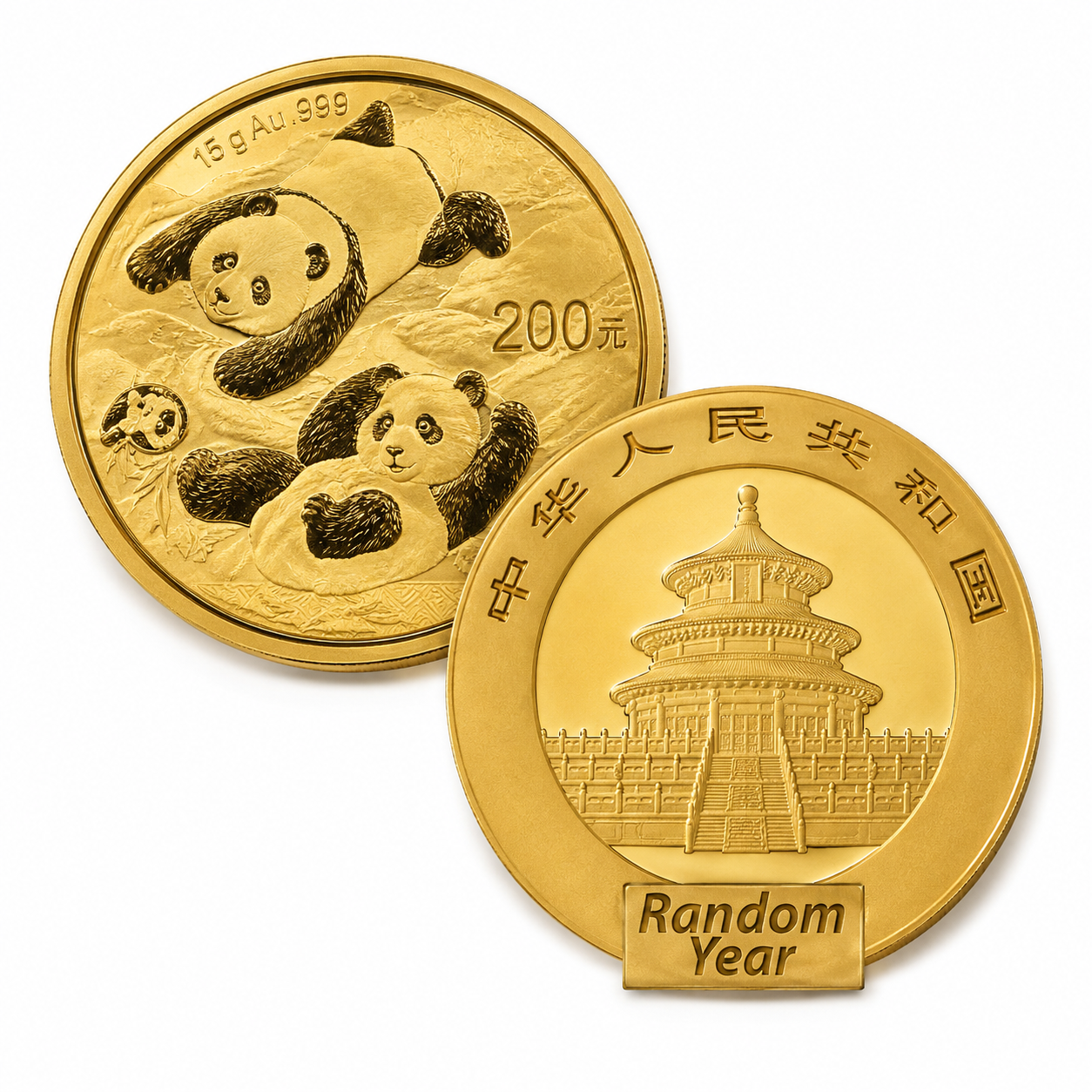
Why the Annual Design Matters for Collectors
Because each year's Panda features a distinct design, collectors often pursue specific years the way they might pursue specific dates in a vintage US coin series — a genuinely different dynamic from a coin like the Silver Eagle, where design consistency means most buyers care about condition and certification far more than the exact year. Certified Panda coins in top grades from specific years can carry a real collector premium beyond bullion value, similar in concept to what's covered in our explainer on what makes gold proof coins different from bullion, though the Panda's premium is driven by design-year scarcity rather than a proof strike specifically.
How It Compares to Coins That Never Change
The American Gold Eagle Coins are the clearest contrast. According to the U.S. Mint, the Eagle's obverse design has remained the same since the coin launched in 1986, with only one reverse redesign in 2021 across the entire nearly-40-year run. The Panda changes its design every single year by design, not by exception. Neither approach is better — a stable design supports easy, uniform recognition at resale, while an annually changing design supports a genuinely different kind of collecting.
Best Use Case
The Panda suits a buyer who wants a well-established, internationally recognized bullion coin with genuine year-to-year collectibility built in, whether or not you plan to actively collect specific years. If you'd rather have the simplest possible bullion purchase with no design variation to think about, a coin with a stable design is a more straightforward choice. Our explainer on what gold bullion actually means covers that bullion-versus-collectible distinction more broadly if you want the full picture.
Frequently asked questions
Why does the Chinese Gold Panda's design change every year?
The program was designed from the start to feature a new panda design on the reverse each year, while the obverse — the Temple of Heaven — has stayed consistent since 1982. This is a deliberate design choice, not an occasional redesign like most other bullion coins have.
Why did the Panda switch from ounces to grams?
Starting with the 2016 release, the program switched to metric weights to align with China's standard measurement system. The former 1 oz coin became 30 grams, and the other sizes shifted proportionally; it's the same coin lineage under a different weight label.
Is a 30 gram Panda the same as the old 1 oz Panda?
Effectively yes — the 30 gram size is the direct metric successor to the pre-2016 1 oz denomination. It's the same position in the size lineup, just measured and labeled differently after the 2016 switch.
Are older Chinese Gold Panda coins worth more than newer ones?
It depends on the specific year, condition, and certification rather than age alone. Some years are more sought after by collectors than others, similar to how specific dates matter more in a vintage US coin series than in a coin with a fixed design.
What fineness is the Chinese Gold Panda?
Chinese Gold Panda coins are .999 fine gold, the same purity standard used across most major gold bullion coins, though some other coins like the American Gold Buffalo use a slightly higher .9999 standard.
Where to go from here
To see other fractional gold options beyond the Panda, browse our Gold Fractionals category for the full range of smaller-size gold coins we carry.
This article is for general information only and is not financial, tax or legal advice. Precious metals prices fluctuate and past performance does not guarantee future results. Consult a licensed financial or tax professional about your own situation.