
The American Gold Buffalo, first struck in 2006, was the U.S. Mint's first-ever 24-karat gold coin — a genuine milestone, since every gold coin the Mint had produced before it used a lower-purity alloy. Its design borrows directly from one of the most beloved coins in American history: James Earle Fraser's 1913 Buffalo Nickel. It was also the first US bullion coin that didn't feature an eagle anywhere on it, a small but notable break from tradition in a lineup otherwise dominated by the bird.
This guide covers the coin's design origins, its record-setting purity, full specs, and how it compares to the Gold Eagle it launched alongside. Browse our Gold American Buffalo Coins to see current options priced off live spot.
A Design Borrowed From an Iconic Nickel
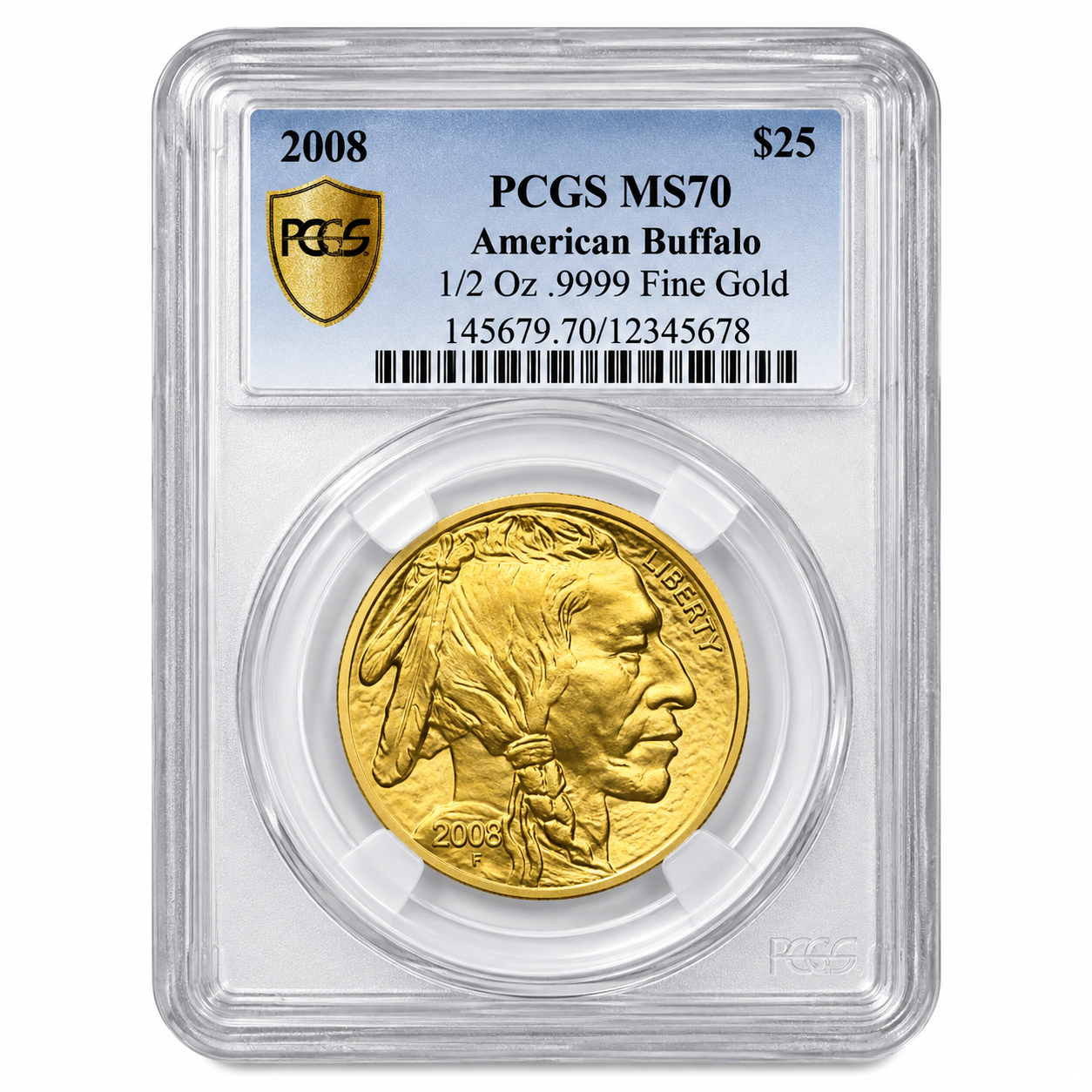
The Buffalo's design comes straight from James Earle Fraser's original 1913 Type I Buffalo Nickel. The obverse features a composite Native American profile that Fraser modeled on several real chiefs who posed for him in the early 1900s, commonly identified as including Iron Tail of the Lakota Sioux and Two Moons of the Cheyenne. The reverse depicts an American bison standing on a mound — the same scene used on the original 1913 nickel. Fraser's nickel design is widely regarded as one of the finest ever produced by the U.S. Mint, which is part of why the Mint chose to revive it decades later for its first pure gold coin.
The First 24-Karat Gold Coin From the U.S. Mint
According to the U.S. Mint announced, the Buffalo was struck for the first time at the West Point Mint on June 20, 2006, and went on sale to the public two days later. It was authorized by the Presidential $1 Coin Act of 2005 and contains one troy ounce of .9999 fine gold — 24 karat, the highest purity tier — with a $50 face value as legal tender. That made it the first pure gold coin the U.S. Mint had ever offered directly to investors and collectors, a genuine break from the Gold Eagle's 22-karat alloy that had been the only US gold bullion option for the previous two decades.
Specs
| Spec | Detail |
|---|---|
| First struck | June 20, 2006 |
| Fineness | .9999 (24 karat) |
| Weight | 31.108 g (1 troy oz) |
| Diameter | 32.7 mm |
| Thickness | 2.95 mm |
| Edge | Reeded |
| Face value | $50 |
| Mint mark | None on bullion strikes; "W" on proof versions |
The Fractional Sizes That Almost Never Existed
Unlike the Gold Eagle, which has been struck in four sizes continuously since 1986, the Gold Buffalo has spent almost its entire run as a 1 oz-only coin. Fractional sizes — 1/2 oz, 1/4 oz, and 1/10 oz — were issued only briefly, as certified proof and burnished pieces rather than as an ongoing bullion lineup. A graded example like our 2008 MS70 American Buffalo 1/2 oz Gold Coin reflects that limited window: fractional Buffalos are collector pieces from a short production period, not a size you'll find in current bullion inventory the way you would with the Eagle.
How It Compares to the Gold Eagle
The Buffalo and the Eagle are the two flagship gold bullion coins from the U.S. Mint, but they differ in purity and durability. According to the U.S. Mint's American Buffalo Coin Program page, the Buffalo's .9999 fineness makes it softer and more prone to surface marks than the Eagle's alloyed 22-karat composition, which trades a small amount of purity for meaningfully better wear resistance. If you want the full breakdown of how the Eagle's sizes compare physically, our guide on Gold Eagle dimensions across its four sizes covers that separately. For proof and certified Buffalo pieces specifically, our explainer on what makes gold proof coins different from bullion covers why those cost more than a standard 1 oz Buffalo.
Best Use Case
The Buffalo suits a buyer who specifically wants the highest available purity in a US-minted gold coin, or who's drawn to its historic Buffalo Nickel design. If durability matters more to you than purity — say, for a coin you expect to handle often — the Eagle's alloy is the more practical choice. Our explainer on what gold bullion actually means covers that fineness trade-off in more general terms if you're still deciding.
Frequently asked questions
When was the American Gold Buffalo first minted?
The U.S. Mint struck the first American Gold Buffalo coins on June 20, 2006, at the West Point Mint, with public sales beginning two days later on June 22, 2006.
Why is the Gold Buffalo 24 karat when the Gold Eagle isn't?
The Buffalo was designed specifically to be the Mint's first pure gold coin, using .9999 fine gold with no alloy. The Eagle predates it by 20 years and used a 22-karat alloy from the start for added durability, a design choice the Mint never changed for that coin.
Does the Gold Buffalo come in fractional sizes?
Only briefly. Unlike the Gold Eagle's four ongoing sizes, fractional Buffalo coins were struck as certified proof and burnished pieces for a limited period rather than as a continuing bullion lineup. Current bullion production is 1 oz only.
Whose portrait is on the Gold Buffalo?
The obverse shows a composite Native American profile that James Earle Fraser based on several chiefs who posed for him in the early 1900s, most commonly identified as including Iron Tail of the Lakota Sioux and Two Moons of the Cheyenne.
Is the Gold Buffalo a good alternative to the Gold Eagle?
It can be, especially if higher purity matters more to you than durability. Both are legitimate, widely recognized U.S. Mint gold coins; the right choice depends on whether you prioritize .9999 fineness or the Eagle's more wear-resistant alloy.
Where to go from here
If you want a certified or proof example, our 2010 Proof Gold Buffalo Coin is one option to compare against a standard bullion strike. And if you're weighing the Buffalo against the Eagle directly, our American Gold Eagle Coins show live pricing for that comparison.
This article is for general information only and is not financial, tax or legal advice. Precious metals prices fluctuate and past performance does not guarantee future results. Consult a licensed financial or tax professional about your own situation.